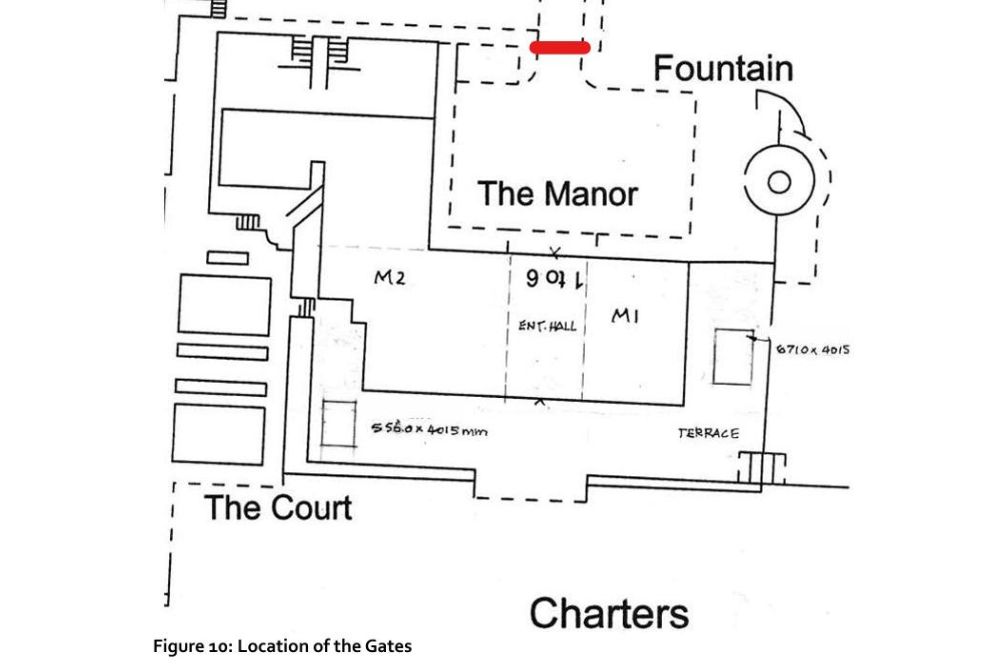
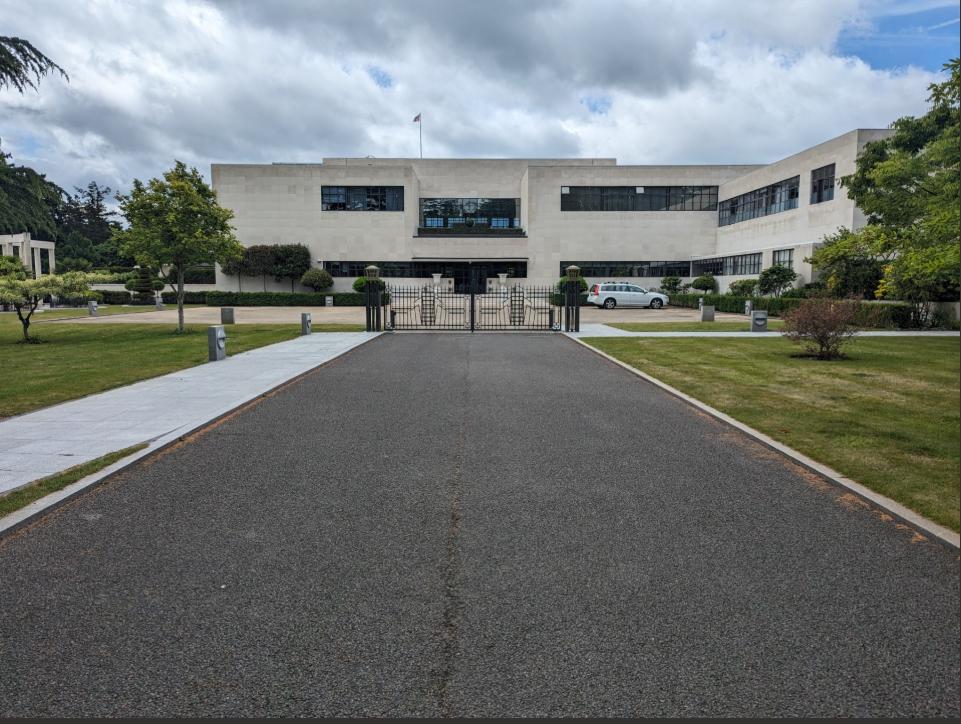
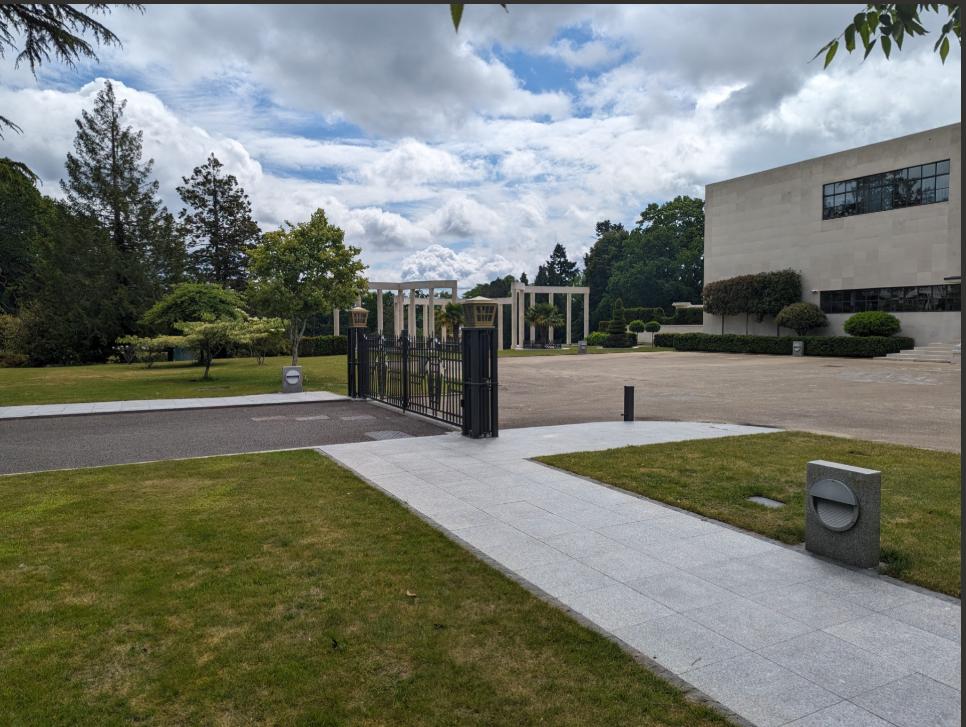
Given the potential for enforcement action and prosecution, WS Heritage were commissioned to seek retrospective approval for the installation of gates within the curtilage of this listed building. As a result of the property’s historic subdivision and a consequent lack of legibility with respect to entrances and associated circulation etc., these were installed with the express intent of managing visitors and deliveries whilst protecting our client’s security and amenity; demarcating the defensible space of the site’s now-principal property.
Land presently hosting Charters was first recorded in the 1780s and in 1865, the estate was then acquired by Edward Hamilton, at which juncture this was to undergo its first major phase of redevelopment. Charters – as built by Hamilton – was then purchased by Frank Parkinson on 10th September 1936. In 1936-7 plans were developed by Adie, Button & Partners – renowned for their ‘ultra-modern buildings’ – to replace the former Victorian country home with a modern dwelling.
The final design exhibited an art deco or modern design ethos, albeit the interior was designed to the preference of Parkinson’s wife and in turn exhibited more traditional Queen Ann, Georgian, and Louis XVI influences, definitively at odds with the building’s external envelope. In 1959, Charters was purchased by Vickers Research Limited and converted to industrial use. In March 1975, Charters was purchased and occupied by De Beers Industrial Diamond Division.
Changes included the development of a sports and social club before thirteen acres were lost to a compulsory purchase order for the purposes of developing the new Charters Secondary School. Following industrial use spanning over forty years, Charters was in 2002 purchased by Saber Developments before being returned to residential use, albeit comprising apartments rather than one single dwelling. Further apartment blocks were also developed over the remainder of the estate.
Given the potential for enforcement action and prosecution, WS Heritage were commissioned to seek retrospective approval for the installation of gates within the curtilage of this listed building. As a result of the property’s historic subdivision and a consequent lack of legibility with respect to entrances and associated circulation etc., these were installed with the express intent of managing visitors and deliveries whilst protecting our client’s security and amenity; demarcating the defensible space of the site’s now-principal property.
Land presently hosting Charters was first recorded in the 1780s and in 1865, the estate was then acquired by Edward Hamilton, at which juncture this was to undergo its first major phase of redevelopment. Charters – as built by Hamilton – was then purchased by Frank Parkinson on 10th September 1936. In 1936-7 plans were developed by Adie, Button & Partners – renowned for their ‘ultra-modern buildings’ – to replace the former Victorian country home with a modern dwelling.
The final design exhibited an art deco or modern design ethos, albeit the interior was designed to the preference of Parkinson’s wife and in turn exhibited more traditional Queen Ann, Georgian, and Louis XVI influences, definitively at odds with the building’s external envelope. In 1959, Charters was purchased by Vickers Research Limited and converted to industrial use. In March 1975, Charters was purchased and occupied by De Beers Industrial Diamond Division.
Changes included the development of a sports and social club before thirteen acres were lost to a compulsory purchase order for the purposes of developing the new Charters Secondary School. Following industrial use spanning over forty years, Charters was in 2002 purchased by Saber Developments before being returned to residential use, albeit comprising apartments rather than one single dwelling. Further apartment blocks were also developed over the remainder of the estate.
Given this somewhat involved history combined with the architectural value that remained to the site at the close of the C20, Charters was designated Grade II on the 28 September 1995, prior to further amendment on 02 January 2020. The new gates reflected the inherently modern design ethos in evidence at Charters and, following negotiation and the regularisation of matters via a retrospective planning application, approvals were successfully granted in January 2026.
Given this somewhat involved history combined with the architectural value that remained to the site at the close of the C20, Charters was designated Grade II on the 28 September 1995, prior to further amendment on 02 January 2020. The new gates reflected the inherently modern design ethos in evidence at Charters and, following negotiation and the regularisation of matters via a retrospective planning application, approvals were successfully granted in January 2026.